



“I’m sorry dada.”
He said it beside me on the stairs, just inside the gate that takes three moves to open. Press down. Slide the latch. Lift. I heard him coming down from the second floor with Doug, through the foyer, and I opened it before he reached me.
Before he asked.
People who have known me for decades read me as stone. That night a two-year-old looked at my face and pulled the true thing off of it. Not anger, which is what sorry usually answers to. Tired. He apologized to the correct feeling.
“I have to poop.”
He said it from the potty, where he had been sitting for twenty minutes holding my phone, “Wheels on the Bus” going around on a loop. He said it in a full sentence.
I have spent my whole life trusting people who speak in full sentences. So I took him off.
He detonated.
Legs kicking. Body flailing. A scream-cry pitched high and holding, and inside it the same sentence, back again in the crying voice. I put him back on. Nothing. Off. Louder. Back on. Off. And under all of it, the song. A bus that never stops moving, on a loop, in a bathroom where nobody was going anywhere.
He’s two, I said. His emotions are a two-year-old’s. And he’s tired. “I want to stand up.”
A new claim. I honored it. I carried a screaming person up a flight and a half of stairs to his bathroom, where the toilet sits low, built for him, and stood him in front of it.
He cried there too.
The whole time, I was negotiating. “You’ve been on the potty for a long time and you haven’t pooped.” “You said you want to stand up. You’re standing up.” I read the terms back to a two-year-old and kept granting what he asked, waiting for the crying to stop the way it stops across a table when the other side gets what they want. He was not at a table.
There was never a table. The table was mine. I carried it into that bathroom like I carry it everywhere, set it down between me and a screaming two-year-old, and slid papers across it.
My body understood before I did. My stomach dropped and kept dropping, the way it does in the first second of a fall, except the second didn’t end. The drop spread. Chest. Hands. The back of the neck. An alarm issued for wolves and fire, going off over a boy in cartoon underwear. Bluey or Spider-Man. I don’t remember. I stared at them and my eyes filed nothing, because the part of me that files things had left to stand guard.
He’s two. His emotions are a two-year-old’s. He’s tired. I said it again. The correct diagnosis, delivered on time by a fluent man, and it reached no one. Including me. His words are big for two. They came from this house. And I had been grading the feelings by the words, assuming a boy who can build a sentence can carry what’s inside one. I knew better while it was happening.
Knowing didn’t help.
Doug took him for the bath. The warm water ended it.
Fifteen minutes of crying with me and every tool I own. Six with Doug and a tub. The house went quiet all at once, quiet enough to hear the sump pump in the cellar.
Pajamas. No one said anything smart.
“I’m sorry dada.”
He came through the open gate, sat down next to me, and said it like the rest of his words. One at a time. Aimed.
I said, “You have nothing to be sorry about. Dada is just tired too.”
He wasn’t wrong. I refused it because of what keeping it would make him: a two-year old holding a grown man’s weather. I was the oldest in a single-parent house with a very young mom. I had a great childhood, and I carried what needed carrying. Both are true. The carrying stops here.
He nodded. Looked down. Moved closer. I put my arm around him and kissed his forehead.
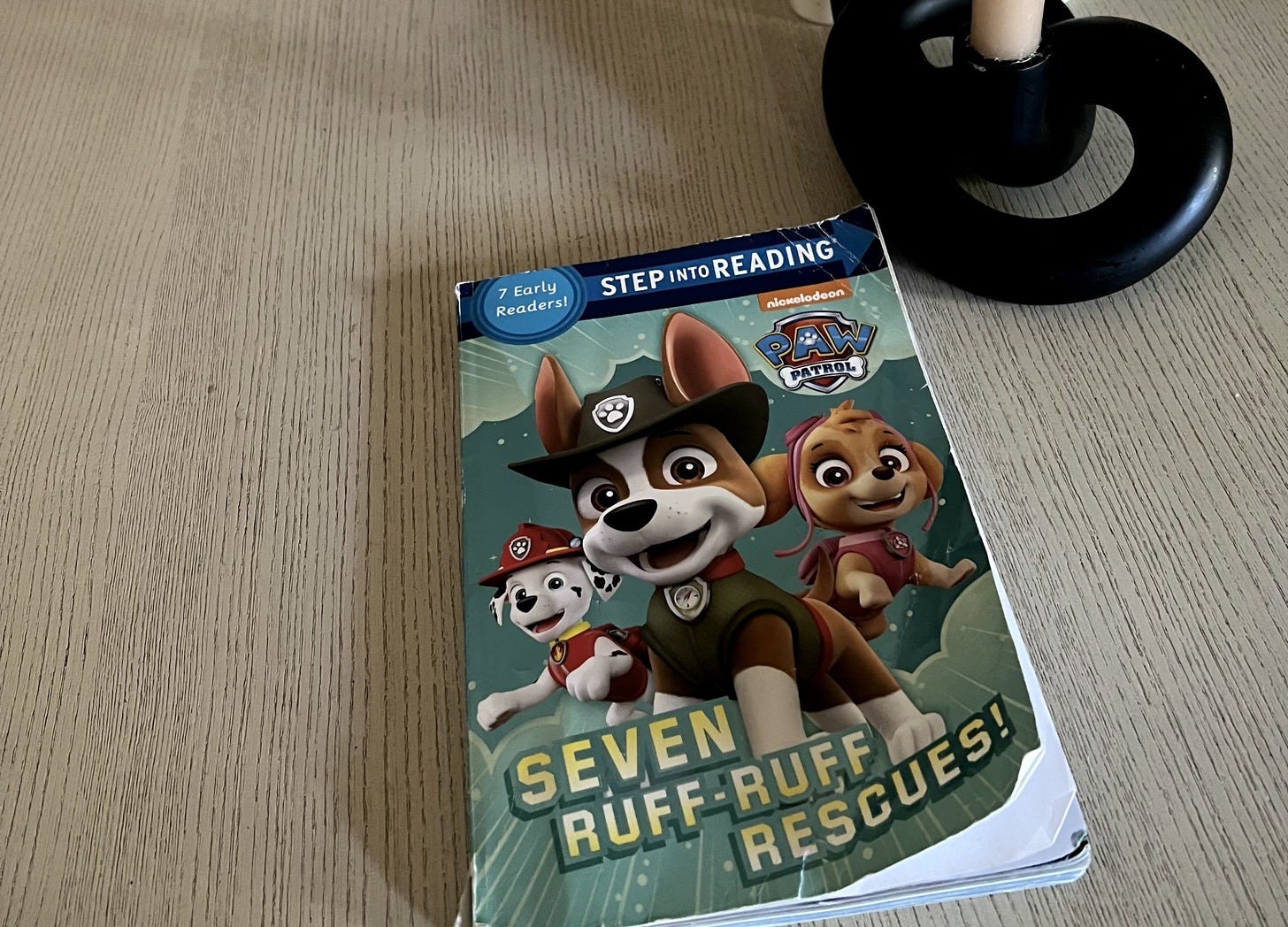
Dinner. Three stories from a Paw Patrol book. Doug took him up.
I sat in our bed working on something else, not this. After a while Doug carried him in, asleep, and laid him down next to me. I shut everything off and held him. He’s two. His emotions are a two-year-old’s.
And I’m tired.
He knew before I did. He said it on the stairs with the wrong sentence and the right aim. Half an hour. Then I got up and went back to work.
Here is the part I would say to someone still in it.
I’m tired. He’s tired. And I was still negotiating.
You have a diagnosis like that somewhere. A true thing you named months ago, about the job, the marriage, the pace, your own body. You say it in the car, in the shower, at dinner, and then keep living like you never said it. I understood everything on those stairs, and by the end of the night I was back at work. Knowing is not a move. I keep learning that.
So the smaller ask, the one I’m working on too: figure out what your warm water is. Not the diagnosis. You have that cold. The thing that would actually end the crying. You don’t have to run the bath yet. Just know where it is.
Still in the middle.


